Illinois Community Care Program: A Guide for Providers
How the Illinois Community Care Program works for in-home providers: CCU authorization, DON scores, service cost maximums, units and provider duties explained.
Resources
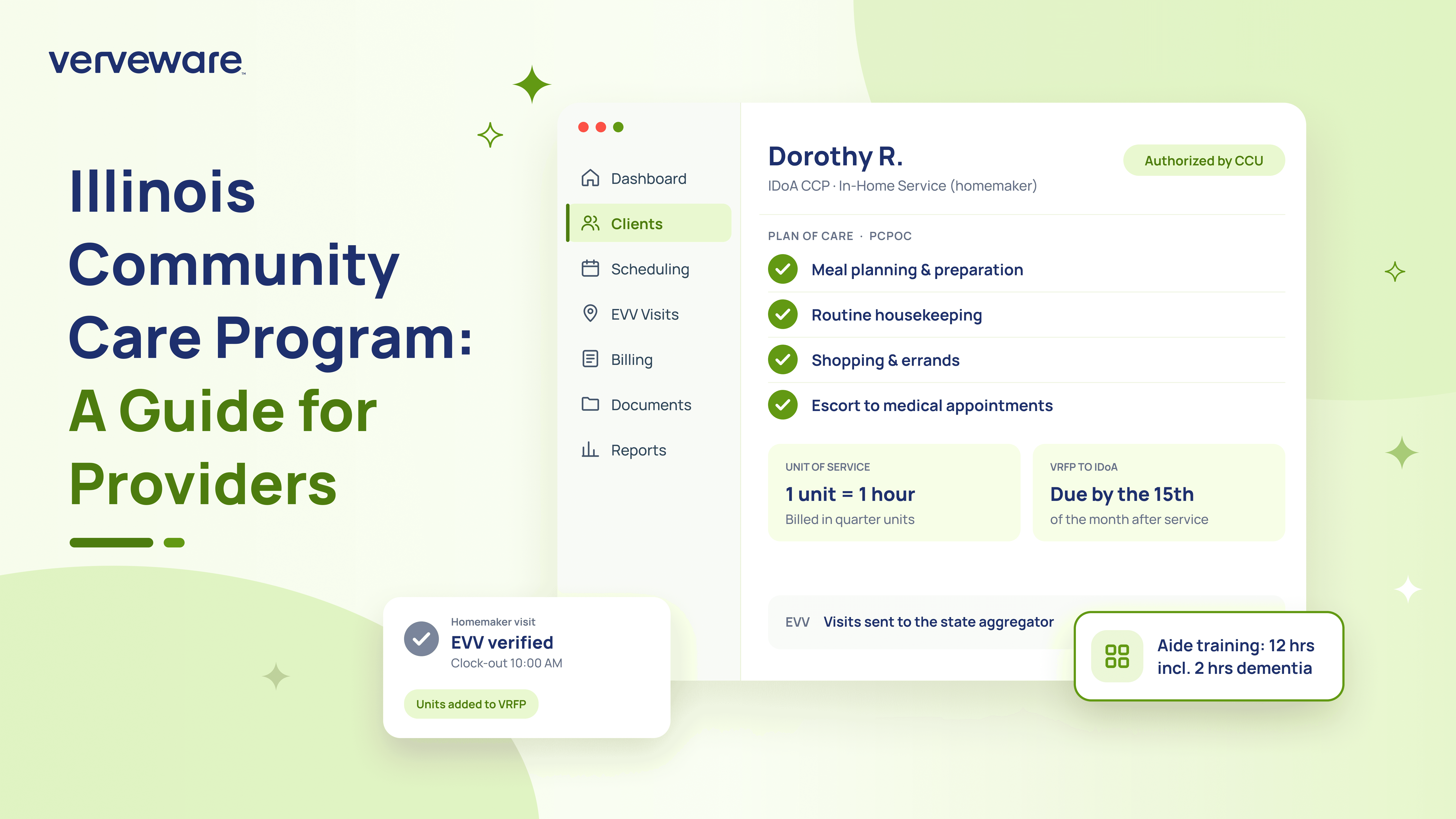
What the Illinois Community Care Program Is
Sagar Kumar, COO and Co-Founder, Verveware
The Illinois Community Care Program (CCP) is how the Illinois Department on Aging (IDoA) helps older adults stay in their own homes instead of moving to a nursing facility. For in-home providers, CCP sets who you serve, what your aides do, how hours are counted and what you owe the state.
CCP services include care coordination, In-Home Service, Adult Day Service, Emergency Home Response and Automated Medication Dispenser Service (IDoA).
To qualify, a participant must be 60 or older, live in Illinois, be a U.S. citizen or eligible non-citizen, have non-exempt assets of $17,500 or less, show an assessed need for long-term care on the Determination of Need (DON), and apply for Medicaid, enrolling if eligible (IDoA).
CCP is separate from the DHS-DRS Home Services Program, which has its own rules and billing.
How CCP Hours Get Authorized
Community Care Program providers don't set a participant's hours. The local Care Coordination Unit (CCU) does:
The CCU assesses the participant and determines eligibility. Plans are reassessed annually unless something changes sooner (IDoA).
The DON score sets eligibility. A participant needs at least 29 points, with 15 from Total Impairment (89 Ill. Adm. Code 240.727).
The person-centered plan of care (PCPOC) is built within a service cost maximum. Maximum monthly service dollars depend on the total DON score and the approved plan, and IDoA posts them on its website (89 Ill. Adm. Code 240.728).
The CCU refers the participant. The participant picks a provider serving their area, or IDoA's rotation plan assigns one. You must start service within 15 days of notice, or within two work days if the participant is at imminent risk of nursing home placement (IDoA).
More on intake in our IDoA referrals guide.
What CCP In-Home Service Covers
IDoA defines In-Home Service as general non-medical support by supervised homecare aides with specialized training (IDoA). Required tasks include:
Meal planning and preparation, including special diets
Routine housekeeping
Shopping and errands
Assisting with self-administered medications
Personal care such as bathing and dressing
Escort or transportation to medical facilities or for essential errands
Providers report critical events within seven days (89 Ill. Adm. Code 240.210).
What Counts as a Unit of Service
One unit of CCP In-Home Service is one hour of direct service in the participant's home, while providing escort or transportation, or while running errands or shopping for the participant (89 Ill. Adm. Code 240.210). Providers bill IDoA in quarter-unit increments, at a fixed unit rate IDoA publishes (89 Ill. Adm. Code 240.1520 and 240.1930).
Billing an Illinois Medicaid MCO is different: those claims use S5130 in 15-minute units. See our S5130 billing requirements.
What Providers Owe the State
CCP providers sign up for ongoing duties under 89 Ill. Adm. Code Part 240:
Billing by the 15th. Submit the Vendor Request for Payment (VRFP) electronically so IDoA receives it by the 15th of the month after service, with units for each participant (240.1520).
Training. Homecare aides need at least 12 hours of in-service training per calendar year, including two hours of dementia training (240.1535).
The 77% rule. At least 77% of total revenues due from IDoA must go to direct service worker costs each reporting year. Missing it can lead to a corrective action plan, then closed intake or contract termination (240.2040).
Background checks, insurance and audits. Health Care Worker Background Check Act and registry checks, general liability and workers' compensation coverage, an annual independent CPA audit, and records kept six years (240.1520).
Where EVV and Billing Fit
Since March 2, 2026, IDoA visit data goes to HHAeXchange, the state's EVV aggregator, whether you use the state-sponsored HHAeXchange portal or a third-party EVV vendor through EDI (HFS). The same applies to DRS. Details are in our IDoA EVV requirements guide, and batch billing shows how your monthly VRFP file gets built.
Keep CCP Hours, Visits and Billing in One Place
Verveware keeps authorized units, visits, EVV and IDoA billing together:
EVV with real-time compliance-rate tracking and a live HHAeXchange integration for Illinois
Audit-ready TTP (Training Tracking Program) reporting for training records
An adult day care module for agencies running both services
Payroll hours export to ADP, Paylocity and QuickBooks
Illinois Community Care Program FAQ
What Is the Illinois Community Care Program?
The Illinois Community Care Program (CCP) is the Illinois Department on Aging program that helps adults 60 and older who might otherwise need nursing home care stay at home. It offers in-home service, adult day service, emergency home response and automated medication dispensers, coordinated locally by Care Coordination Units.
What Does CCP In-Home Service Include?
CCP In-Home Service is non-medical support from supervised, specially trained homecare aides. Tasks include meal preparation, housekeeping, shopping and errands, assisting with self-administered medications, personal care such as bathing and dressing, and escort or transportation. Aides follow the participant's person-centered plan of care and report changes in condition.
How Many CCP Hours Can a Participant Get?
The local Care Coordination Unit decides. A participant needs a DON score of at least 29 to qualify, and the total DON score sets the maximum monthly service dollars. The CCU builds the person-centered plan of care within that limit, and providers deliver the hours it authorizes.
What Is One Unit of CCP In-Home Service?
One unit is one hour of direct service, whether in the participant's home, while providing escort or transportation, or while shopping or running errands for them. Providers bill IDoA in quarter-unit increments at a fixed rate IDoA publishes. Illinois Medicaid MCO claims use S5130 in 15-minute units instead.
When Are CCP Bills Due to IDoA?
IDoA must receive your electronic Vendor Request for Payment (VRFP) by the 15th of the month after the service month. The VRFP lists the units of service delivered to each participant, billed in quarter-unit increments, and you keep supporting documentation for audits.
What Is the 77% Rule for CCP Providers?
In-home providers must spend at least 77% of total revenues due from IDoA on direct service worker costs each reporting year. The remaining 23% can cover administrative and program support. Missing the threshold can lead to a corrective action plan, then closed intake or contract termination.
See How Verveware Handles CCP
See authorized units, EVV and IDoA billing working together for your agency. Book a demo.


